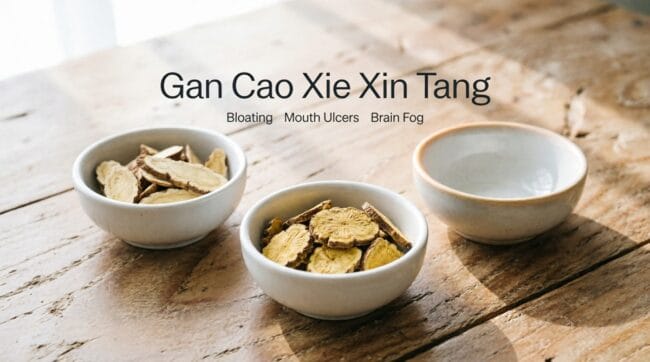
 When healthy habits become unhealthy
Many people today are trying hard to improve their health. They follow the latest wellness trends, drink green smoothies, skip breakfast, practice intermittent fasting, take numerous supplements, and rely on several strong coffees throughout the day to maintain energy.
Yet despite these efforts, many still experience:
- Bloating
- Excessive gas
- Abdominal discomfort
- Food sensitivities
- Reflux
- Fatigue
- Brain fog
- Irregular bowel habits
- Mouth ulcers
- Poor appetite
- A feeling that digestion is simply “not working properly”
From a traditional Chinese medicine perspective, these symptoms may reflect what classical physicians described as a disruption of the digestive system’s ability to transform food and fluids effectively.
More than 1,800 years ago, Chinese physicians developed herbal formulas to address these complex digestive patterns. One such formula is Gan Cao Xie Xin Tang (Licorice Decoction to Drain the Epigastrium).
An ancient formula from the Shang Han Lun
Gan Cao Xie Xin Tang was first recorded in the ancient Chinese medical text the Shang Han Lun, written around 220 CE.
The formula was designed for patients experiencing a condition known as “Pi” syndrome—a feeling of fullness, blockage, discomfort, and digestive dysfunction occurring when the stomach and intestines are no longer functioning in harmony.
Unlike many formulas that focus solely on excess or deficiency, Gan Cao Xie Xin Tang addresses a mixture of both.
Traditional ingredients
The classical formula contains:
- Gan Cao (Licorice Root)
- Ban Xia (Pinellia Rhizome)
- Huang Qin (Scutellaria Root)
- Huang Lian (Coptis Rhizome)
- Gan Jiang (Dried Ginger)
- Da Zao (Jujube Dates)
Some traditional versions also include Ren Shen (Ginseng).
These herbs work together to:
- Harmonise the stomach and intestines
- Support digestive function
- Direct rebellious stomach qi downward
- Address heat and inflammation
- Warm digestive weakness
- Support the body’s recovery and repair processes
Traditional signs and symptoms
Classical indications for Gan Cao Xie Xin Tang include:
- Fullness or discomfort below the ribs or in the upper abdomen
- Bloating
- Borborygmus (loud intestinal sounds)
- Loose stools or irregular bowel motions
- Nausea
- Poor appetite
- Reflux
- Digestive weakness
- Irritability
- Mouth ulcers
A key feature is the presence of mixed signs—where heat and cold, excess and deficiency, may all be present simultaneously.
A modern interpretation: digestive dysregulation
Many contemporary Chinese medicine practitioners view Gan Cao Xie Xin Tang as a useful foundation for patients experiencing what might be described as a dysregulated digestive system.
This often includes people who have:
- Been dieting for years
- Skipped regular meals
- Relied heavily on coffee for energy
- Consumed large quantities of raw foods and cold smoothies
- Practised prolonged fasting despite digestive weakness
- Taken numerous supplements without addressing underlying digestive function
- Experienced chronic stress
While these habits may be promoted as healthy in some circumstances, they can sometimes place significant strain on digestion, particularly when used excessively or without consideration of an individual’s constitution.
Over time, people may develop:
- Bloating after meals
- Food intolerances
- Constipation or loose stools
- Reflux
- Fatigue
- Brain fog
- Poor nutrient absorption
- Chronic digestive discomfort
From a Chinese medicine perspective, the digestive system may become weakened, irritated, and unable to effectively regulate the movement and transformation of food and fluids.
Oral ulcers and Behçet’s syndrome
One of the more interesting modern applications of Gan Cao Xie Xin Tang is in conditions involving chronic inflammation of mucosal tissues.
Chinese medicine practitioners have used variations of this formula for:
- Recurrent mouth ulcers
- Chronic oral inflammation
- Digestive inflammation
- Certain presentations associated with Behçet’s disease
In these situations, practitioners often observe a combination of digestive dysfunction together with inflammatory symptoms affecting the mouth and digestive tract.
Rather than focusing solely on clearing heat or inflammation, the formula attempts to restore harmony to the digestive system while addressing the inflammatory process.
Why individualisation matters
One of the strengths of Chinese herbal medicine is that formulas are rarely prescribed exactly as written in ancient texts.
Gan Cao Xie Xin Tang is often used as a base formula.
Depending on the individual’s presentation, a registered Chinese medicine herbalist may:
- Add herbs to strengthen digestive function
- Add herbs to reduce bloating
- Modify herbs for constipation or loose stools
- Adjust herbs for reflux and nausea
- Increase herbs for mouth ulcers or inflammatory symptoms
- Change dosages according to the patient’s constitution and presentation
This allows treatment to be tailored to the individual rather than simply matching a diagnosis.
Professional guidance is important
Gan Cao Xie Xin Tang is a traditional Chinese herbal formula that should only be prescribed by appropriately qualified practitioners.
The formula is commonly used as a foundation prescription, with additions, subtractions, and dosage adjustments made according to each patient’s individual presentation and requirements.
About Heiko Lade
Heiko Lade is a registered Chinese medicine practitioner with more than 40 years of clinical experience.
He is a member of Acupuncture NZ and practises in accordance with professional and regulatory standards applicable to Chinese medicine practitioners in New Zealand.
Educational disclaimer
The information contained in this article is provided for educational purposes only and is intended to promote understanding of traditional Chinese medicine principles.
It is not intended to diagnose, treat, cure, or prevent any disease and should not be regarded as individual medical advice.
Chinese herbal medicine prescriptions should only be prescribed following an appropriate consultation with a qualified practitioner.
This article has been prepared in accordance with the educational intent requirements of the New Zealand advertising and professional practice framework.
