Eczema: Why Elbow & Knee Points Are Bled (The Tung Acupuncture Perspective)
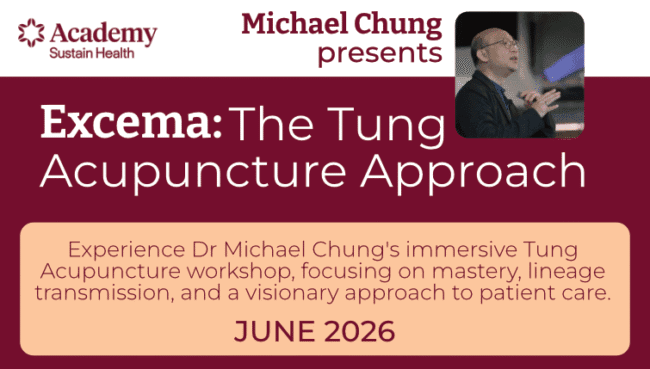
This blog was inspired from some of the learnings from my previous training with Dr Michael Chung. Dr Michael Chung, direct lineage disciple of the Master Tung acupuncture methods will be teaching again in June 2026 in Melbourne including eczema as well as many other conditions. Details how to register at the end of this post.
Eczema that localises and often first appears at the elbows and behind the knees is not random—it reflects a deeper channel-level phenomenon occurring at the body’s major “hinge zones” where Qi, Blood, and fluids change direction.
In classical terms from the Ling Shu, Tai Yang represents the exterior entry of Yang, while Tai Yin represents the interior entry of Yin. Functionally, the Lung governs the skin and pores, and the Bladder governs the exterior and surface distribution of Wei Qi.
When this interface becomes disrupted, wind-damp tends to lodge at transitional zones rather than being properly released.
Why the elbows and knees? (Si Wan / 四弯)
The elbow creases and popliteal fossae are known in Tung acupuncture as the “four curves of wind.” These are regions where:
- Channel Qi changes direction
- Movement is frequent but not always smooth
- Fluids tend to accumulate
- Wind-damp can become embedded
- The basic Tung acupuncture starting points- Bleed Lu 5 chi ze and Bl 40 wei zhong
Clinically, eczema commonly appears here because these are interfaces between movement and stagnation—ideal environments for pathogenic wind-damp to persist.
Pathomechanism (channel-level view)
A common pattern progression is:
- External wind enters via Tai Yang
- Internal dampness (often Spleen-related) provides a substrate
- Transformation into wind-damp or damp-heat
- Lodgement at channel transition zones (Si Wan)
At this stage, the pathology is primarily within the channel and collateral layer, rather than deep organ pathology.
Why bleeding is used
Bleeding at elbow and knee regions is a classical Tung-style method aimed at:
- Clearing heat at the blood level
- Moving Qi and Blood in the collaterals
- Dispersing wind-damp from its point of lodgement
- Restoring the opening/closing function of the surface
- Re-establishing normal Lung dispersing and Bladder exterior function
In Tung terms, these sites function as release gates—points where pathogenic factors can be vented when trapped in transitional zones.
Lung–Bladder functional axis
The Lung (Tai Yin) and Bladder (Tai Yang) form a key functional pairing:
- Lung → governs skin, pores, dispersal and descending
- Bladder → governs exterior defence and surface circulation
When this axis is impaired, we often see:
- Impaired surface regulation
- Accumulation of fluids in the interstices
- Persistent wind-damp in the channels
- Chronic eczema in flexural regions
Bleeding Si Wan helps restore this axis by encouraging outward movement and relieving channel-level obstruction.
Tung acupuncture approach for skin disorders
Tung-style treatment typically combines local release with systemic regulation of Qi, Blood, and fluids.
Commonly used points from the Tung Acupuncture system to address dermatological presentations include:
- Zhi Wu 11.26
- Zhi Si Ma 11.07
- Si Ma Trio (88.17–88.19)
These are often selected for their ability to move Qi and Blood, clear heat, and resolve channel obstruction, and are frequently paired with Si Wan bleeding when eczema is localised to flexural regions with wind-damp or damp-heat.
Considerations with prolonged topical steroid use
Topical corticosteroids can be effective in reducing inflammation and pruritus; however, prolonged or repeated use may lead to both local and systemic effects.
From a biomedical perspective, possible effects include:
- Skin atrophy and thinning
- Striae formation
- Telangiectasia
- Pigment changes
- Reduced local immune response
- Tachyphylaxis with repeated use
- Potential systemic absorption in extensive or long-term application
From a TCM perspective, this can be understood as:
- Depletion of Yin fluids and Blood
- Suppression of Wei Qi at the surface
- Closure of the exterior while underlying imbalance persists
- Disruption of Lung function in regulating the skin and pores
Clinically, this may present as:
- Rebound flares after discontinuation
- Migration of symptoms to other areas
- More chronic, mixed-pattern presentations involving Qi, Blood, and fluids
Summary
Eczema in the elbow and knee regions reflects pathology at channel transition zones where Tai Yin (Lung) and Tai Yang (Bladder) interact. Bleeding these areas functions to release wind-damp from the channel layer, clear heat, and restore normal surface dynamics.
When combined with distal Tung points such as Zhi Wu 11.26, Zhi Si Ma 11.07, and the Si Ma trio (88.17–88.19), treatment addresses both local obstruction and systemic imbalance of Qi, Blood, and fluids.
Registered practitioners of acupuncture from New Zealand and Australia who are interested in exploring the Tung Acupuncture system are invited to attend the workshop below.
📍 Tung’s Acupuncture Workshop 2 – Melbourne
For practitioners looking to deepen their understanding and clinical application of Tung acupuncture methods, Dr Michael Chung be teaching an upcoming workshop:
Tung’s Acupuncture Workshop 2
📅 30th July – 2nd August 2026
📍 Melbourne
