Exercise is often treated as a simple matter of fitness—but in reality, different types of movement affect the body in very different ways. Some exercise builds strength, some improves cardiovascular output, and some directly influences how well blood reaches the smallest tissues in the body. Understanding these differences helps explain why two people can appear equally “fit,” yet have very different underlying health and circulation patterns.
Exercise is often discussed in terms of how much we should do—but not all exercise affects the body in the same way. From both a Western physiology perspective and Traditional Chinese Medicine (TCM), it is useful to distinguish between how different types of movement influence circulation, structure, and recovery.
A simple way to understand this is to separate circulation into two layers:
- Macro circulation → heart, arteries, overall cardiovascular output
- Microcirculation → capillaries, tissue perfusion, local blood flow
Different types of exercise emphasise these layers in different ways.
🧠 The Good: Exercise that supports both big and small circulation
These forms of exercise improve overall cardiovascular health and help blood reach the smallest vessels.
Examples you can do at home:
- Walking (especially uphill or stairs)
- Brisk walking in intervals
- Cycling (if available)
- Qigong / Tai Chi / internal martial arts
- Breath-led movement practices including yoga
Why they work:
- Improve cardiac output (macro circulation)
- Enhance endothelial function (vessel lining health)
- Promote capillary perfusion over time
- Encourage relaxation of the nervous system, supporting tissue-level blood flow
🏋️ The Middle: Strength and structural training
These are essential components of health, but their primary effects differ from aerobic or internal movement.
Examples:
- Light weights (e.g. 2 × 5 kg dumbbells)
- Planks and push ups
- Horse stance (Ma Bu)
- Bodyweight resistance work
What they do:
- Build muscle and structural integrity
- Support joints and posture
- Improve metabolic health
Circulation effect:
- Supports overall health and macro circulation
- Indirectly supports microcirculation when combined with movement, breathing, and recovery
🏃 The Runner’s Pattern: Macro-focused exercise
Running is a highly effective form of exercise, but it is important to understand its primary emphasis.
Running predominantly improves macro circulation—cardiovascular output and systemic blood flow.
Over time, it can also improve microcirculation through adaptation, but:
- The main stimulus is systemic (heart, lungs, large vessels)
- Microcirculation benefits are secondary and depend on consistency, recovery, and overall balance
Running also has additional considerations:
- It can be habit-forming due to endorphin release
- It is repetitive and load-bearing on joints (especially knees, hips, and ankles) and a clinical note here: I rarely see a patient who has had an injury from walking as opposed runner injuries are commonly seen in clinic
- Without complementary training, it may create imbalance over time
⚡ The Bad (when unbalanced): Overuse, repetition, and lack of variation
This does not mean the exercise itself is bad—but the pattern of practice can become problematic.
Clinical observation: As a practitioner, it is common to see injuries in individuals who:
- Begin exercising later in life and progress too quickly
- Or focus excessively on a single activity (for example, only running or only tennis)
Over time, this can lead to:
- Localised overuse injuries
- Joint wear and tear
- Reduced recovery capacity
- Imbalances in the musculoskeletal system
🩸 A key insight: Not all exercise improves microcirculation equally
- Some exercise improves heart and large vessel flow
- Some improves tissue-level perfusion
- Some builds strength but does not directly enhance circulation at the micro level
This explains why individuals may appear physically fit while still showing signs of sluggish microcirculation at a tissue level.
🌿 A practical home-based approach
From both a traditional and modern perspective, a balanced routine is simple and sustainable:
- Daily walking (ideally with some incline or stairs)
- Short strength work (planks, light weights, horse stance)
- Stretching (full, deliberate, not merely gentle)
- At least twenty minutes of qigong or breath-focused movement
On stretching: Traditions such as yoga, Shaolin training, and internal martial arts emphasise daily stretching. Bruce Lee also incorporated daily flexibility work as a core component of his physical training.
Why daily stretching matters:
- Maintains joint range of motion
- Keeps fascia and connective tissue pliable
- Supports circulation through tissues
- Helps prevent stiffness and restriction
- Complements both strength and cardiovascular training
- From a TCM perspective, stretching is especially beneficial for the Liver system, as it helps to keep the tendons flexible and nourished, supporting smooth flow and reducing tension patterns in the body
🧘 A practitioner’s perspective on consistency
In practice, aiming for 45 minutes to 1 hour of movement daily works well for many people, provided there is flexibility in intensity.
The key principles are:
- Consistency over time
- Variation across the week
- Awareness of recovery and fatigue
A useful way to frame this comes from experienced internal arts teachers. For example, Michael Goodhue, a qigong master who teaches on Waiheke Island and has practiced qigong for nearly 30 years, expresses it quite simply: “You brush your teeth every day, you have a bowel movement each day, so you do your exercise each day. Shaolin monks didn’t just train three nights a week.”
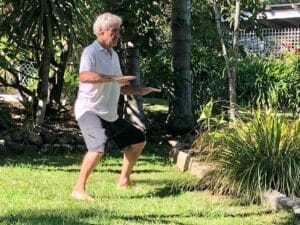
Michael Goodhue doing the horse stance
The underlying principle is rhythm rather than rigidity—daily maintenance of the body as part of normal living.
Not every day needs to be intense. Some days can be lighter, more restorative, or more focused on mobility, breath, and stretching.
And as Michael Goodhue states: ” Some days I have an off day from training and just do a 30 minute walk”
⚖️ Bottom line
Daily movement is better than occasional intense training.
The goal is not simply to do more exercise, but to maintain:
- Balance
- Variation
- Recovery
- Long-term sustainability
Exercise should build health, not gradually create new imbalances. The best routine is one that can be maintained consistently over years without breaking the system.
🌿 Closing perspective: movement as daily maintenance of the system
From a broader viewpoint, exercise is not just a fitness activity—it is a form of daily regulation of the body’s internal environment.
- Movement supports circulation of Qi and Blood
- Stretching keeps the tendons flexible and nourished (Liver system in TCM)
- Strength training supports structure and resilience (Kidney and overall integrity)
- Aerobic activity supports cardiovascular output and systemic flow
- Breath-based and internal practices help regulate the nervous system and improve coordination between systems
When these elements are combined in a balanced and sustainable way, the body maintains better circulation at both the macro and micro levels.
Rather than thinking in terms of isolated workouts, it is more useful to think in terms of daily cultivation—small, consistent inputs that, over time, preserve function, mobility, and vitality.
In this sense, exercise becomes less about performance and more about maintaining flow, balance, and long-term health.
