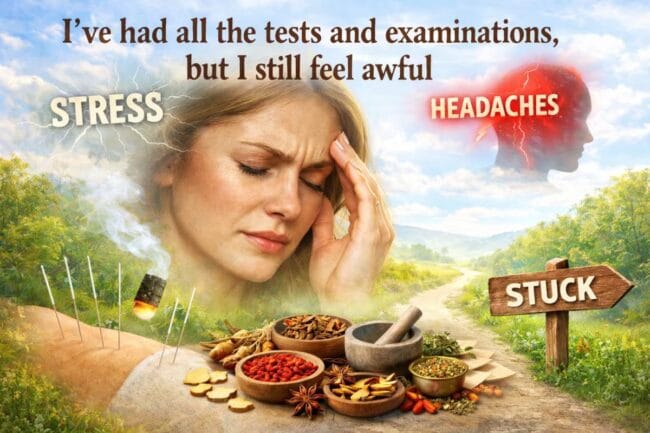
If you’ve ever said this, you are not alone so read on and discover why symptoms can persist even when medical tests are normal. Have you had specialist visits only still to be told everything is normal?
Many women come into clinic saying:
- “My blood tests are normal.”
- “My scans are clear.”
- “I’ve been told everything is fine… but I don’t feel fine.”
Symptoms like fatigue, anxiety, poor sleep, digestive issues, menstrual changes, or a general sense of “not being right” can persist even when standard medical tests show no clear diagnosis.
This does not mean nothing is happening—it often means the issue is functional rather than structural.
When the body is out of balance, but not broken
Modern testing is very effective at detecting disease once clear structural changes have occurred.
However, many people experience a stage before this—where the body is still functioning, but not regulating smoothly.
In traditional Chinese medicine, this often relates to functional systems such as:
- Liver Blood (nourishment and regulation)
- Spleen function (energy production and digestion)
- and Wei Qi (the body’s protective and adaptive system)
These are not single organs, but networks of function that influence energy, resilience, mood, digestion, and recovery.
The Liver, stress, and emotional load
In traditional Chinese medicine, the Liver system is closely involved in:
- emotional regulation
- menstrual health
- smooth flow of energy and circulation
- overall internal coordination
When stress becomes ongoing, or emotions are suppressed, the Liver system may become strained.
This can be experienced as:
- irritability or emotional sensitivity
- tension in the body
- headaches
- menstrual changes
- feeling mentally “overloaded” or stuck
Over time, this may contribute to a pattern where nourishment and recovery (often described as “Blood”) are not fully restored between life demands.
The Chinese medicine Spleen system and energy production explained
The Spleen system is responsible for:
- digestion and nutrient extraction- we say the stomach takes in the food and the spleen processes the food
- energy production
- building and maintaining Blood and fluids- it sends the nutrients to the four limbs and keeps them warm
When this system is under strain—commonly from stress, overthinking, irregular eating, or prolonged fatigue—people may experience:
- persistent tiredness
- bloating or digestive discomfort
- brain fog
- low motivation
- difficulty recovering from exertion or stress
Wei Qi explained in modern terms (immune + stress regulation system)
In traditional Chinese medicine, Wei Qi is often described as the body’s protective energy.
A more modern way to understand Wei Qi is as a combination of:
- immune system responsiveness
- autonomic nervous system regulation (fight/flight vs rest/digest balance)
- stress adaptation capacity
- and the body’s ability to respond appropriately to environmental change
When Wei Qi is strong, the body tends to:
- adapt well to stress
- recover quickly from illness
- remain stable through weather and environmental changes
When it is weakened or dysregulated, people may notice:
- increased sensitivity to stress
- feeling run down more easily
- fluctuations in energy and symptoms
- being more affected by changes in weather, especially cold, wind, or damp conditions
From a modern perspective, this reflects a system with reduced resilience and regulatory flexibility, rather than a single disease process.
Why symptoms often fluctuate
Many women notice their symptoms change depending on:
- stress levels
- menstrual cycle phases
- sleep quality
- weather changes
- emotional load
This pattern suggests the issue is often not fixed damage, but a dynamic imbalance in regulation and recovery.
The role of viruses and post-illness changes
In some cases, people notice that their health changed after an illness such as flu, glandular fever, or COVID. Commonly they say “I have been the same since….”
Certain viral infections such as:
- Epstein-Barr virus
- Cytomegalovirus
- COVID-19
may be associated with longer-term changes in energy, immune responsiveness, or recovery capacity in some individuals.
This does not necessarily mean an active infection, but rather a system that remains more sensitive or easily disrupted after stress or illness.
Common conditions seen in this pattern
This type of functional imbalance may be associated with a range of presentations, including:
- menstrual irregularities
- painful or heavy periods
- endometriosis-related symptoms
- perimenopausal changes
- chronic fatigue
- anxiety or low mood
- sleep disturbance
- headaches or migraines
These are not separate, unrelated problems, but may represent different expressions of underlying regulation and recovery imbalance.
The key idea: capacity vs demand
A useful way to understand this pattern is:
It is often not that something is “broken,” but that the body’s recovery capacity is being exceeded by ongoing demand.
This creates a cycle of:
- improvement with support
- followed by relapse under stress
- followed by recovery again
What treatment aims to support
The goal of treatment in this model is not only symptom relief, but to help support:
- physiological resilience
- nervous system regulation
- energy and recovery capacity
- hormonal and cycle stability
- digestive and nutritional function
Over time, this helps reduce the tendency for symptoms to repeatedly return.
Advertising and Regulatory Compliance (NZ)
This content and any associated product descriptions are written in line with the Advertising Standards Authority of New Zealand guidelines and the Therapeutic Products Advertising Code.
Accordingly:
No claim is made that the product or services offered treats, cures, or prevents any medical condition.
Statements about traditional uses are clearly identified as coming from Traditional Chinese Medicine, not modern western clinical research.
No health promises are made that would imply guaranteed cure or clinical efficacy.
Readers are encouraged to seek professional medical advice and consult with a registered Chinese medicine practitioner for diagnosis and treatment.
Want to Learn More?
If you’re interested in personalised support, please contact Heiko Lade at The Acupuncture Clinic in Hastings for a private consultation, who can assess your individual pattern and recommend a tailored treatment plan. Heiko Lade has had over 40 years experience and is a registered Chinese medicine practitioner with Chinese Medicine Council of New Zealand.
In Hamilton, contact Kane Monrad at Connect Therapies. If you reside elsewhere within New Zealand, you can contact Acupuncture NZ for your nearest registered Chinese medicine practitioner.
