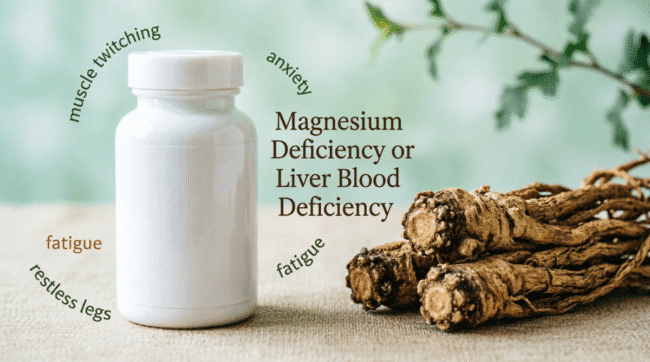
Magnesium Deficiency vs Liver Blood Deficiency
Two languages describing similar body patterns
Many people experience symptoms such as:
- muscle cramps or twitching
- poor sleep or waking at night
- anxiety or feeling “wired but tired”
- irritability or low stress tolerance
- restless legs or tension in the body
In modern physiology, these symptoms are often associated with low or functionally depleted magnesium status.
In Traditional Chinese Medicine (TCM), a very similar cluster of signs may be described as a pattern involving Liver Blood deficiency, sometimes with internal wind or failing to anchor the Shen (spirit/mind).
While these systems come from different traditions, they often describe overlapping functional states of the nervous system.
⚡ Magnesium in the modern body
Magnesium is a key mineral involved in:
- ATP energy production
- nerve stability and signaling
- muscle relaxation
- stress regulation
When magnesium is low or functionally depleted, the nervous system can become more excitable, leading to:
- twitching or cramps
- poor sleep regulation
- increased sensitivity to stress
- muscle tension and restlessness
Importantly, magnesium deficiency is not always obvious on standard blood tests.
🧪 Testing magnesium levels (What tests exist?)
1. Serum magnesium (blood test)
- Most commonly used in standard medicine
- Easy and widely available
- Limitation: only reflects ~1% of body magnesium
👉 You can have normal results but still have low tissue levels.
2. RBC magnesium (red blood cell magnesium)
- Measures magnesium inside cells
- Better reflection of longer-term status
- Not always routinely available
3. Magnesium loading / retention tests
- Measures how much magnesium is retained after administration
- More accurate in research settings
- Not commonly used in general practice
Key takeaway
Magnesium status is difficult to measure directly, and symptoms are often more clinically useful than a single lab result.
🌿 Liver Blood deficiency (TCM perspective)
In TCM, Liver Blood is responsible for:
- nourishing the sinews and muscles
- anchoring the mind (Shen)
- supporting emotional stability
- maintaining smooth flow of Qi
When Liver Blood is insufficient, common patterns may include:
- muscle tension or tremors
- poor sleep or waking at night
- anxiety or emotional reactivity
- visual strain or fatigue
- restlessness in the body or mind
In some cases, this may be accompanied by “wind-like” movement signs such as twitching or internal agitation.
⚖️ Side-by-side comparison (simplified)
| Symptom pattern | Magnesium depletion (modern view) | Liver Blood deficiency (TCM view) |
|---|---|---|
| Muscle twitching | Neuromuscular excitability | Sinews not nourished |
| Poor sleep | Reduced GABA regulation | Shen not anchored |
| Anxiety / irritability | Increased neural excitability | Liver not smoothing Qi |
| Restless legs | Electrolyte imbalance | Wind / nourishment deficiency |
| Fatigue | ATP inefficiency | Blood not nourishing tissues |
⚠️ Important distinction
Although the patterns overlap, they are not identical.
- Not all Liver Blood deficiency symptoms are related to magnesium
- Not all magnesium deficiency presents as a full blown TCM Liver pattern
They are best understood as:
Two different languages describing overlapping functional states of the nervous system
🧩 Why symptoms don’t always mean magnesium deficiency
Similar symptoms can also be caused by:
- chronic stress (high cortisol)
- poor sleep patterns
- thyroid imbalance
- blood sugar instability
- anxiety disorders
- medication effects
- general fatigue or overwork
This is why clinical context matters more than any single symptom or test.
🥣 Magnesium-rich foods
Dietary sources include:
- pumpkin seeds (one of the richest sources)
- almonds and walnuts
- leafy green vegetables (spinach, kale)
- oats
- dark chocolate (especially 85–95%)
And my personal favorite practical option:
pumpkin seed brittle made with walnuts, almond, coconut, honey and maple syrup
These foods provide magnesium alongside fats, fiber and trace minerals that support absorption.
🌿 Chinese herbs often used for similar patterns
In TCM, herbs that are commonly used in patterns resembling nervous system overactivity or poor sleep include:
- Suan Zao Ren (Ziziphus seed) – calms the mind and supports sleep
- Fu Shen (Poria spirit portion) – settles the Heart and Shen
- He Huan Pi (Albizia bark) – supports emotional regulation
These herbs are traditionally used to address the pattern, not magnesium levels directly.
🪡 Acupuncture and magnesium-like symptoms
Acupuncture is commonly used for symptoms such as:
- muscle cramps
- insomnia
- anxiety
- tension headaches
- restless legs
From a modern biomedical perspective, acupuncture may influence:
- autonomic nervous system regulation
- endorphin and neurotransmitter release
- muscle tone and circulation
A key question remains:
Does acupuncture regulate magnesium metabolism directly, or does it reduce the stress physiology that drives magnesium depletion?
At present, this is still not fully understood. It may involve both:
- improved nervous system regulation
- reduced stress-driven mineral loss
- improved functional balance of neuromuscular systems
🔥 Stress: the hidden driver
One of the most important factors in magnesium depletion is stress.
This includes:
- emotional stress (worry, anxiety, conflict)
- lack of sleep
- chronic workload pressure
- physical overexertion
- illness or infection
Stress increases magnesium loss through:
- urinary excretion
- increased cellular demand
- higher ATP turnover
This means that even a good diet may not fully compensate during high-stress periods.
🧠 Speculative but interesting perspective
A key question in integrative medicine is:
If we regulate Liver Blood and Spleen function in TCM, does this reduce the need for magnesium supplementation?
From a modern perspective, this could be interpreted as:
- improved digestion and absorption
- reduced stress hormone load
- improved nervous system stability
- better retention of minerals
While this is not yet scientifically proven, it raises an interesting possibility:
Different systems may be describing interventions that improve the same underlying physiological balance.
⚠️ Disclaimer (NZ-safe wording)
Heiko Lade is a Registered Traditional Chinese Medicine Practitioner with the Chinese Medicine Council of New Zealand (CMCNZ).
This article is provided for educational purposes only and is intended to support general understanding of health concepts from both Traditional Chinese Medicine and modern physiological perspectives.
It is not intended to diagnose, treat, cure, or prevent any disease. Individuals with health concerns should consult a qualified healthcare practitioner.
