A changing view of endometriosis
Endometriosis has traditionally been understood in both biomedicine and Chinese medicine through fairly established frameworks: retrograde menstruation, inflammation, Blood stasis, and Liver Qi stagnation. In clinical practice, many traditional prescriptions—most notably formulas such as Gui Zhi Fu Ling Wan— which has been widely used. In fact, it is the most commonly prescribed Chinese herbal formula in Taiwan for endometriosis, yet results are varied.
Clinically, there remains a subgroup of patients who do not respond as expected. This raises an important question: are we always treating the true driver of disease, or sometimes only its downstream expression?
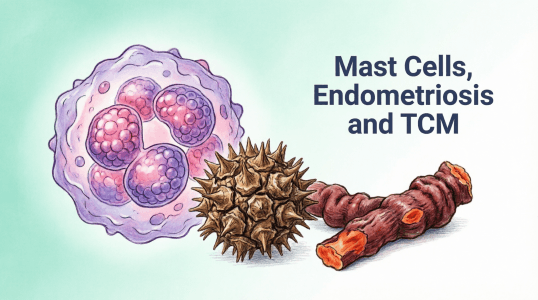
In recent years, a growing body of biomedical research has shifted attention toward the immune system—particularly mast cells—as a key player in endometriosis.
Mast cells: the missing link in chronic inflammation
Mast cells are immune cells found throughout the body, particularly at barrier interfaces such as the skin, gut, lungs, and reproductive tract. Their primary role is to respond rapidly to perceived threats.
When activated, mast cells release a range of inflammatory mediators including:
- Histamine
- Cytokines (such as IL-6 and TNF-α)
- Prostaglandins
- Nerve growth factors
While this response is protective in acute settings, chronic or inappropriate activation can lead to persistent inflammation, pain sensitisation, and tissue dysfunction.
In endometriosis, research has demonstrated increased mast cell presence and activation within lesions, suggesting they may contribute to both pain generation and disease progression.
The gut–immune connection
A key development in modern immunology is the recognition that the gut plays a central role in immune regulation.
Dysbiosis, intestinal permeability, and altered microbial metabolism can all influence systemic immune behavior. In particular:
- Increased gut permeability may expose the immune system to inflammatory triggers
- Microbial imbalance may promote histamine production
- β-glucuronidase activity may influence estrogen recirculation
From this perspective, the gut is not separate from pelvic disease—it may be one of the primary drivers of immune activation.
A different view of “Blood stasis”
In traditional Chinese medicine, endometriosis is often treated as a Blood stasis disorder, and moving Blood is considered central to treatment.
However, from a modern immunological perspective, Blood stasis may be better understood as a downstream consequence of chronic inflammation, microvascular dysfunction, and immune-mediated tissue change.
In other words, the visible pathology in the pelvis may reflect a deeper upstream process involving immune dysregulation rather than being the root cause itself.
Why some classical approaches may fall short
Formulas such as Gui Zhi Fu Ling Wan are historically important and clinically useful in many presentations of pelvic pain and Blood stasis. However, in a subset of patients—particularly those with:
- IBS or gut sensitivity
- allergic tendencies
- histamine reactions
- cyclical inflammatory flares
- systemic immune reactivity
The primary driver may not be static Blood alone.
Instead, these cases appear to involve a broader pattern of immune dysregulation that is not fully addressed by Blood-moving strategies alone.
A combined biomedical and Chinese medicine model
A more integrated model of endometriosis may look like this:
- Gut dysfunction and microbial imbalance
- Immune activation and mast cell sensitisation
- Cytokine and inflammatory mediator release
- Increased aromatase activity and local estrogen amplification
- Pelvic inflammation, lesion persistence, and secondary Blood stasis
From a Chinese medicine perspective, this can be loosely mapped to:
- Yangming internal Heat tendency
- Latent pathogenic influence (伏邪)
- Secondary Blood stasis and local obstruction
This interpretation shifts the focus from purely “moving Blood” to regulating deeper systemic drivers of inflammation.
A modern Chinese herbal strategy: gut, immune, and pelvic layers
1. Gut and immune entry regulation
Mai Ya
Huo Xiang
Yi Yi Ren
Gan Cao
Sheng Jiang
This layer focuses on stabilising the gut–immune interface, which emerging biomedical research suggests may be a key upstream regulator in some cases of endometriosis.
From this perspective, the gastrointestinal system is not separate from pelvic disease, but part of the same immune network. Dysbiosis, impaired digestion, and increased intestinal permeability may all contribute to immune activation and inflammatory signalling.
The herbal strategy here is deliberately gentle and functional rather than aggressive. It aims to:
- reduce digestive burden and fermentation load
- support gastrointestinal function and motility
- reduce gut-derived inflammatory signaling
- stabilise mucosal barrier integrity
- reduce immune activation originating from the gut
Mai Ya helps reduce food stagnation and digestive load, lowering inflammatory by-product formation.
Huo Xiang supports digestive transformation and helps regulate damp-type digestive dysfunction.
Yi Yi Ren provides a key bridge between digestion and immune regulation, with modern evidence suggesting anti-inflammatory and gut-modulating effects.
Gan Cao supports mucosal protection and reduces gastrointestinal inflammatory irritation.
Sheng Jiang assists digestive harmony and motility regulation.
Together, this layer reduces immune activation originating from the digestive system.
2. Immune and mast cell modulation layer
Cang Er Zi
Mu Dan Pi
Huang Qin
This layer aims to regulate mast cell activity, reduce inflammatory cytokine signaling, and calm immune over-reactivity. It represents the central immune regulatory axis of the model.
3. Pelvic and tissue expression layer
Chi Shao
Dan Shen
Niu Xi
Lu Lu Tong
This layer addresses downstream pelvic pathology, including microcirculatory disturbance, inflammatory lesion persistence, pain generation, and local immune–vascular dysfunction.
Rather than being the root of disease, these manifestations are viewed as the downstream expression of systemic immune dysregulation.
A shift in thinking
This model does not reject traditional Chinese medicine. Instead, it reframes it.
Rather than viewing endometriosis purely as Blood stasis or Qi stagnation, it suggests that in some patients the condition may reflect a deeper pattern of:
- immune dysregulation
- gut–immune interface instability
- chronic inflammatory signaling
Blood stasis, in this context, becomes the visible outcome of a longer pathological cascade rather than its origin.
Conclusion
Endometriosis is increasingly understood as a complex, multi-system condition involving hormonal, immune, and inflammatory components. The emerging role of mast cells provides a potential bridge between modern immunology and traditional Chinese medicine concepts of Heat, latent pathology, and Blood stasis.
For clinicians, this opens the possibility of a more layered treatment strategy—one that addresses not only pelvic symptoms, but also the upstream gut–immune interactions that may sustain the disease process.
While further research is needed, this integrative perspective may help explain why some patients respond well to classical approaches, while others require a broader regulatory strategy targeting immune and gut function alongside pelvic circulation.
Clinical framework summary (practitioner box)
Core hypothesis:
Endometriosis (subset) = chronic immune dysregulation driven by gut–immune interface instability and mast cell activation, with secondary pelvic Blood stasis.
System layers
1. Gut / immune input control
- Mai Ya
- Huo Xiang
- Yi Yi Ren
- Gan Cao
- Sheng Jiang
↓ reduces immune triggering load
2. Immune / mast cell modulation
- Cang Er Zi
- Mu Dan Pi
- Huang Qin
↓ reduces cytokine + histamine signalling
3. Pelvic expression layer
- Chi Shao
- Dan Shen
- Niu Xi
- Lu Lu Tong
↓ addresses downstream inflammation, pain, microcirculation, adhesion tendency
Clinical principle
Treat upstream immune activation first, pelvic Blood stasis as downstream expression, not primary cause.
Patient phenotype most suitable
- IBS / gut reactivity
- histamine-type symptoms
- inflammatory cyclical pain
- allergy tendency
- “reactive system” presentations
Disclaimer
This article is intended for educational purposes only. It presents a theoretical integrative model combining contemporary biomedical concepts with traditional Chinese medicine frameworks. It is not intended to diagnose, treat, cure, or prevent any disease.
The herbal strategies described represent a suggestive base framework only and require modification based on individual presentation, constitution, and clinical assessment.
Readers should consult a registered Chinese medicine practitioner under the Chinese Medical Council of New Zealand (or relevant local regulatory authority) before considering any treatment approach discussed.
