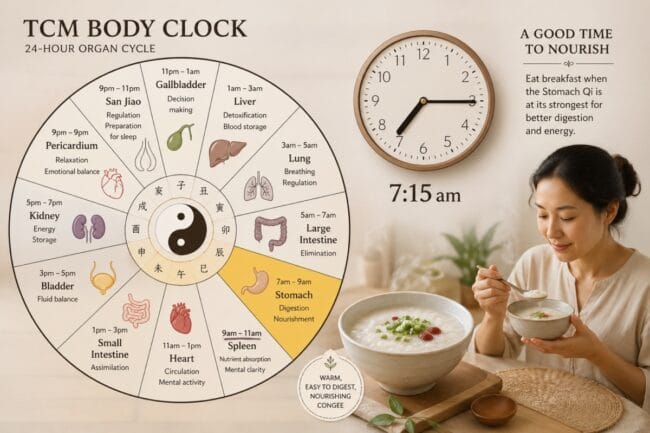
The Chinese “body clock” is a well-known Traditional Chinese Medicine (TCM) concept that maps different organ systems to 24-hour cycles of the day.
Each organ is said to have a two-hour window where its activity or energy (Qi) is at its peak.
But is this simply an ancient framework—or does it reflect something we can still recognise in modern physiology?
The TCM body clock explained
In Traditional Chinese Medicine, the day is divided into 12 organ time periods:
- 5–7am (Large Intestine): bowel movement and elimination
- 7–9am (Stomach): digestion is strongest, ideal time for breakfast
- 9–11am (Spleen): nutrient absorption and mental clarity
- 11am–1pm (Heart): circulation and cognitive activity
- 1–3pm (Small Intestine): assimilation of nutrients
- 3–5pm (Bladder): fluid metabolism
- 5–7pm (Kidney): energy, recovery, and reserves
- 7–9pm (Pericardium): relaxation and emotional regulation
- 9–11pm (San Jiao / Triple Burner): preparing the body for rest
- 11pm–1am (Gallbladder): decision-making and bile function
- 1–3am (Liver): blood storage and metabolic processing
- 3–5am (Lung): respiration and regulation
In clinical practice, this often translates into simple, practical guidance such as:
- Eating a balanced breakfast in the morning
- Supporting regular bowel habits
- Avoiding heavy meals late at night
- Prioritising sleep before midnight where possible
What does modern science say?
Western medicine does not describe organ systems operating in fixed two-hour cycles.
However, it strongly recognises that the body runs on a daily biological rhythm known as the circadian rhythm.
This internal clock influences hormones, digestion, sleep-wake cycles, and cardiovascular function.
When we compare the two models, some interesting overlaps appear:
- Morning bowel activity (5–7am):
The gastrocolic reflex is often strongest after waking, supporting natural elimination. - Morning digestion (7–9am):
Digestive activity and metabolic regulation tend to be more efficient earlier in the day. - Early morning respiratory pattern (3–5am):
Respiratory conditions such as asthma can be more pronounced in the early morning. - Night-time liver function (1–3am):
The liver is highly active metabolically during sleep, supporting glucose regulation and processing functions.
Where the models differ
Not every part of the Chinese clock aligns directly with Western physiology:
- Cardiovascular events are more commonly observed in the early morning, rather than midday “Heart time”
- There is limited evidence that the gallbladder has a peak functional window at midnight
- The San Jiao (Triple Burner) is a functional concept in TCM and does not correspond to a single anatomical structure
So while patterns exist, the clock is not a literal on/off map of organ activity.
Daylight saving time – a modern example
A simple example many people recognise is the effect of daylight saving time changes.
Even though it is only a one-hour shift, many people notice disrupted sleep, changes in energy, and altered digestion for several days or even weeks afterwards.
From a Western perspective, this is explained by temporary disruption of the circadian rhythm, as hormones such as melatonin and cortisol take time to adjust.
From a TCM perspective, this could be viewed as a temporary misalignment of the body’s natural timing systems.
Different frameworks—similar observation:
The body does not instantly adapt to changes in timing.
Why this matters in clinic
Where the Chinese body clock becomes useful clinically is not as a rigid rule, but as a pattern recognition tool.
For example:
- Waking consistently between 1–3am may suggest an underlying Liver-related pattern in TCM terms
- Ongoing sluggish bowel function in the morning often reflects disrupted digestive rhythm
- Late eating combined with poor sleep commonly shows up in both sleep and digestive symptoms
This is also why sleep is strongly emphasised in Traditional Chinese Medicine.
From a TCM perspective, the Liver is considered most active during the night, and adequate sleep supports this natural process.
Symptoms such as nocturia (waking to urinate at night) may seem minor, but can disrupt sleep quality and the body’s ability to fully restore overnight.
So—fact or fiction?
The Chinese body clock is not a literal biological timetable in the Western medical sense.
However, it is also not without relevance.
It can be viewed as an early system for observing biological rhythms—many of which we now understand through the science of circadian biology.
Different language, overlapping observations.
A simple takeaway
You do not need to follow the clock strictly.
However, working with your body’s natural rhythm may be helpful in general:
- Eating earlier in the day
- Supporting regular digestion
- Winding down in the evening
- Prioritising consistent sleep
Small consistent habits often make a meaningful difference over time.
In clinic
In practice, we often see people as part of an individual wellness plan, where the focus is on supporting the body’s natural rhythms over time.
This may include working with digestion, encouraging more regular bowel function, and supporting healthier sleep patterns where appropriate.
The aim is to support optimal function within the person’s overall health picture, using a gradual and individualised approach.
Professional note
This article is provided for general educational purposes only and is not intended to diagnose, treat, cure, or prevent any medical condition. Individual health concerns should be discussed with a qualified healthcare professional.
This content has been prepared in accordance with relevant professional guidance, including the standards of Acupuncture New Zealand and the ASA New Zealand, and is intended for educational and informational purposes only. No therapeutic claims are made.
Want to Learn More?
If you’re interested in personalised support, please contact Heiko Lade at The Acupuncture Clinic in Hastings for a private consultation, who can assess your individual pattern and recommend a tailored treatment plan. Heiko Lade has had over 40 years experience and is a registered Chinese medicine practitioner with Chinese Medicine Council of New Zealand.
In Hamilton, contact Kane Monrad at Connect Therapies. If you reside elsewhere within New Zealand, you can contact Acupuncture NZ for your nearest registered Chinese medicine practitioner.
