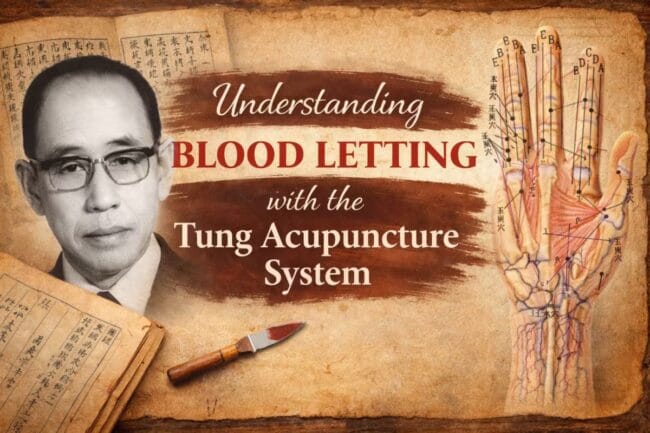
Blood letting can sound confronting at first. Many people associate it with outdated historical practices that were often excessive and poorly understood. However, the method used in modern acupuncture—particularly within the Tung Acupuncture System—is very different.
This article explains what blood letting is, how it is used safely in clinical practice, and why it can be effective from both a traditional and modern scientific perspective.
What Is Blood Letting in Tung Acupuncture?
In the Tung system, blood letting involves releasing a very small amount of blood—usually just a few drops—from tiny superficial vessels in specific areas of the body.
These areas are not chosen randomly. They are part of what we call body “zones”, where one part of the body reflects another. This is sometimes described as a “mirror” or “holographic” system.
For example:
- The inner foot can reflect the pelvic and reproductive region
- The top of the foot can reflect the chest and breast area
This allows us to treat conditions in one part of the body by working on another.
Understanding Body Zones (A Simple Explanation)
Instead of only treating where the pain or issue is located, Tung acupuncture uses the idea that the body is interconnected.
Think of it like this:
- Your body has “maps” within it
- Certain areas correspond to others
- By stimulating one area, we can influence another
Two practical examples:
1. Prostate / Pelvic Region
We often observe small visible veins on the inner side of the foot (near the ankle).
This area corresponds to the pelvic region, including the prostate.
When these veins appear engorged or prominent, it may reflect:
- Local congestion
- Reduced circulation
- Inflammatory processes in the pelvic area
2. Breast / Chest Region
Similarly, the top of the foot—especially between the long bones (metatarsals)—can correspond to the breast and chest.
Visible or raised veins in this area may be associated with:
- Breast tenderness
- Hormonal congestion
- Circulatory stagnation in the chest
Why Do These Veins Appear?
From a modern medical perspective, visible superficial veins can indicate:
- Microcirculatory congestion (blood not flowing efficiently)
- Inflammatory load in the tissue
- Local vascular changes due to stress, hormones, or chronic irritation
In simple terms:
The body is showing us where circulation is not optimal.
These visible signs give us useful clinical clues.
How Blood Letting Is Performed
The technique is very gentle and controlled.
- A sterile, single-use lancet is used
- Only superficial skin is pricked
- A few drops of blood are released
- The area is then cleaned and dressed
The entire process takes only a few seconds.
There is no large blood loss, and most patients are surprised at how minimal it feels.
How Does It Work? (Modern Perspective)
While traditional Chinese medicine describes this as “moving blood and clearing stagnation,” modern science offers several complementary explanations:
1. Improves Microcirculation
Releasing a small amount of stagnant blood encourages:
- Fresh blood flow into the area
- Better oxygen delivery
- Removal of metabolic waste
2. Reduces Local Congestion
Think of it as relieving pressure in a tiny, congested vascular area.
This can reduce:
- Swelling
- Tissue tension
- Discomfort
3. Stimulates Healing Responses
A small, controlled micro-stimulation triggers the body to:
- Activate repair mechanisms
- Release growth factors
- Resolve low-grade inflammation
4. Influences the Nervous System
The skin and blood vessels are rich in nerve endings.
Stimulating these areas can:
- Send signals to the spinal cord and brain
- Influence related body regions through reflex pathways
This helps explain how treating the foot can affect areas like the breast or prostate.
5. Supports Fascia and Fluid Movement
Modern research shows that the body’s connective tissue (fascia) plays a major role in fluid movement and communication.
Improving circulation in one area can:
- Enhance overall tissue mobility
- Support healthy fluid exchange
- Reduce “stagnation-like” patterns
__________________________________________________________________
6. Any small vascular injury triggers
- Endothelial cells → release nitric oxide
- Nitric Oxide causes:
- Vasodilation
- Improved perfusion
- Anti-inflammatory effects
👉 This is a huge overlap with acupuncture research in general
What Patients Often Notice
Patients commonly report:
- A sense of relief or lightness in the affected area
- Reduction in pressure or discomfort
- Improved mobility or ease of movement
In some cases, changes can be felt quite quickly.
Is It Safe?
Yes—when performed by a trained and registered Chinese medicine practitioner.
Safety measures include:
- Single-use, sterile equipment
- Proper skin preparation
- Minimal and controlled technique
- Adherence to professional hygiene standards
Blood letting is not suitable for everyone and may not be recommended in certain conditions (e.g. bleeding disorders, certain medications, pregnancy in specific cases).
A full consultation will always be carried out to ensure the treatment is appropriate and safe for you.
Final Thoughts
Blood letting in the Tung acupuncture system is:
- Precise
- Minimal
- Clinically targeted
Rather than being an outdated practice, it can be understood as a modern, controlled way of:
Improving circulation, reducing congestion, and supporting the body’s natural healing processes.
At The Acupuncture Clinic, acupuncture point prescriptions are individually tailored following a consultation.
The author, Heiko Lade, is a registered practitioner of Traditional Chinese Medicine in New Zealand with over 40 years of clinical experience, and has a special interest in The Tung Acupuncture System.
If you have any questions or are curious whether this approach may be helpful for you, feel free to ask during your consultation.
Disclaimer
To comply with the Advertising Standards Association of NZ and TAPS, please note: I, Heiko Lade, am a registered Acupuncturist and Chinese herbalist in New Zealand with over 40 years of experience. This blog is for educational purposes only and is not a substitute for professional medical advice, diagnosis, or treatment. Always consult a qualified health professional before making decisions about your health
