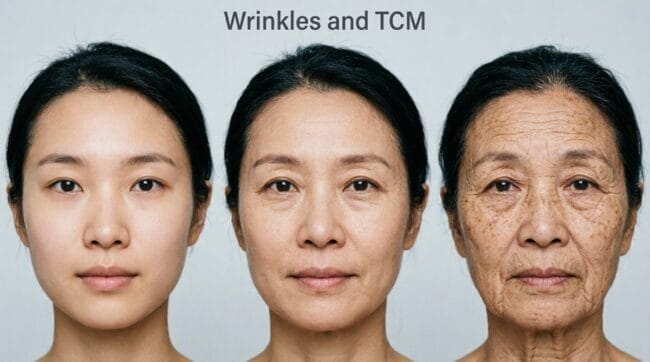
In modern skincare, wrinkles are often explained as a loss of collagen, sun damage, or gravity. Chinese medicine offers a different lens: the face is a living reflection of your internal nourishment, and one system in particular holds the key to skin vitality— The Yang Ming.
What Is Yang Ming?
Literally translated as “Yang Brightness,” Yang Ming isn’t a single organ or a thin line on an acupuncture chart. It’s a functional ecosystem.
A helpful way to picture it is to think of two major highways. In the body, these are the Stomach and Large Intestine channels. But Yang Ming isn’t just the pavement—it’s the entire landscape between them: the soil, the watersheds, the towns that rely on those roads for supplies, and the infrastructure that keeps everything running.
In Chinese medicine, that “terrain” is your digestive capacity, fluid metabolism, muscle and connective tissue tone, and the nourishment pipeline that rises from your core to your face. The channels act as the primary routes, but Yang Ming governs everything they serve. Classical texts describe it as “rich in qi and blood” and call it the “Sea of Water and Grain.” When this system flows smoothly, the skin stays dewy, resilient, and well-toned. When the terrain dries out or the highways get congested, the face is often the first place to show it.
Ancient Roots: The *Huangdi Neijing
The concept of Yang Ming first appears in the Huangdi Neijing (Yellow Emperor’s Inner Canon), compiled over two millennia ago. The Neijing mapped Yang Ming as one of the twelve primary meridian systems, noting its direct pathway across the cheeks, forehead, and jawline. More importantly, it linked the channel’s vitality to facial complexion, moisture, and tissue integrity. It was here that Chinese medicine first recognized the face not as an isolated surface, but as the visible endpoint of an internal nourishment network.
How the Shang Han Lun elevated the understanding
In the early 3rd century CE, physician Zhang Zhongjing transformed Yang Ming from an anatomical concept into a dynamic clinical framework in his masterpiece, the Shang Han Lun (Treatise on Cold Damage). While the Neijing described Yang Ming’s physiological role, Zhang Zhongjing revealed how it behaves under stress: as a stage of intense internal heat, dryness, and fluid consumption. He showed that when pathogenic heat lodges in the Stomach and Large Intestine terrain, it doesn’t just cause digestive discomfort—it rapidly depletes the body’s foundational fluids and dries out the tissue matrix. His systematic approach gave practitioners precise strategies to clear heat, preserve moisture, and protect the nourishment that keeps skin supple.
The Age 35 Turning Point (and Why Wrinkles Appear)
Chinese medicine tracks human development in natural cycles. For women, life unfolds in seven-year phases. According to Chapter 1 of the Su Wen (the foundational section of the Neijing):
“At thirty-five (5 × 7), the Yang Ming vessels begin to decline, the face starts to lose its luster, and the hair begins to thin.”
This isn’t a warning—it’s a physiological milestone. Around age 35, the Stomach system’s natural rhythm of transformation and distribution naturally slows. Less qi and fluid reach the facial terrain, the skin’s “internal dew” diminishes, and fine lines begin to settle. In TCM, wrinkles aren’t just surface cracks; they’re the topographical map of that nourishment landscape losing moisture, structural support, and upward circulation.
The Modern Takeaway
Stress, irregular eating, chronic dehydration, overwork, and diets heavy in heating or drying foods can accelerate this natural decline. So can exposure to drying substances—cigarette smoke being the most notorious. In Chinese medicine terms, smoke is intensely drying and heating; it scorches the Lung and Stomach yin, depletes fluids, and disrupts the Yang Ming terrain from the inside out. This is precisely why smokers often develop premature wrinkles, dull complexion, and chronically dry skin: the internal moisture that should be rising to nourish the face is being burned away.
But Chinese medicine doesn’t treat aging as a flaw to erase. It treats it as a rhythm to support. By calming internal heat, protecting fluids, strengthening digestion, and keeping the Yang Ming terrain open, we can help the skin retain its vitality long past 35.
Nourishing the Terrain Today
It’s no coincidence that facial acupuncture, Chinese herbal therapy, and classical dietary guidance are experiencing a global resurgence. These practices don’t just work on the surface—they target the Yang Ming ecosystem at its root:
Facial acupuncture stimulates local qi and blood flow along the Stomach and Large Intestine pathways, but its true longevity comes from pairing it with systemic treatment that restores the body’s fluid matrix.
Chinese herbs such as Mai Men Dong (Ophiopogon), Shi Hu (Dendrobium), and Bai Shao (White Peony) are traditionally used to nourish Yin, generate fluids, and cool residual heat so the terrain stays hydrated from within.
TCM dietary advice emphasizes warm, easily transformed foods, mindful hydration, and eating rhythms that align with Stomach peak hours (7–9 AM). Less digestive strain means more usable nourishment rises to the face.
When we stop treating wrinkles as isolated surface damage and start tending to the Yang Ming terrain that feeds them, aging becomes less about decline and more about sustained nourishment. The highways stay open. The soil stays moist. And the face reflects the vitality that’s been carefully cultivated from the inside out.
The author, Heiko Lade, is a registered practitioner of Traditional Chinese Medicine in New Zealand with over 40 years of clinical experience, and herbal medicine forms an important part of the traditional system used in his clinical practice.
Educational Disclaimer
This article is provided for educational and informational purposes only. It is not intended to diagnose, treat, cure, or prevent any medical condition and reflects traditional Chinese medicine theory.
Always consult a registered Chinese Medicine practitioner for personalised guidance regarding your skin, diet, or wellbeing.
