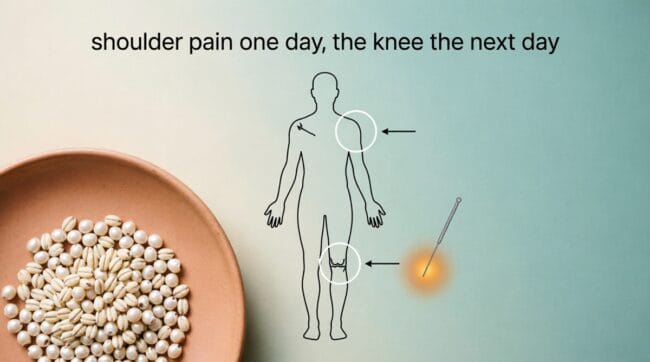
 A simple explanation from both Chinese medicine and modern science
One of the most common questions patients ask in clinic is:
“Why does my pain keep moving? One day it’s my shoulder, then my knee, then my wrist.”
From a Chinese medicine perspective, this is often described as “wind” — but what does that actually mean?
Let’s break it down in a way that makes sense.
The Chinese Medicine View: “Wind”
In Traditional Chinese Medicine (TCM), conditions like arthritis are often described as Bi syndrome — meaning obstruction in the channels.
When the pain:
- Moves from joint to joint
- Changes location over time
- Comes and goes unpredictably
…we describe this as “wind Bi”.
Why?
Because in nature, wind moves — it doesn’t stay still.
So in the body, “wind” is a way of describing movement and changeability.
Patient question: “Yes, but what does that mean medically?”
This is where it gets interesting — because modern medicine does have explanations that line up surprisingly well.
1. The immune system doesn’t attack evenly
In inflammatory arthritis (like rheumatoid arthritis), the immune system is overactive.
- It releases inflammatory chemicals (cytokines) into the bloodstream
- These travel through the body
- But they don’t inflame every joint at the same time
So what happens?
- Monday: swollen wrist
- Friday: wrist improves, knee flares
👉 The inflammation has shifted location
Modern research shows that inflammation markers (like CRP, ESR) fluctuate and correlate with disease activity across different joints
TCM translation: Wind moving through the channels
2. The nervous system can “move” pain
Sometimes the pain isn’t just coming from the joint itself.
The brain and spinal cord can become more sensitive — a process called central sensitisation.
- Pain signals get amplified
- The “map” of the body in the brain shifts
- Pain can appear in different places without clear injury
👉 This makes pain feel like it’s wandering
TCM translation: Internal wind
3. The body compensates (and shifts stress)
If one joint hurts, you naturally move differently.
- Limp → load shifts
- Shoulder stiff → neck overworks
- Knee sore → hip compensates
Over time:
👉 Pain appears in a new joint
It feels like the pain has “moved” — but actually, the load has moved
TCM translation: Wind stirring underlying dampness or weakness
4. Multiple joints are involved — but flare at different times
In many arthritis conditions:
- Several joints are mildly inflamed at once
- But only some cross the “pain threshold” at any given time
So the pain seems to:
- appear
- disappear
- reappear elsewhere
👉 Not random — just fluctuating inflammation
How Acupuncture May Help
From a TCM perspective, treatment aims to:
- Expel wind
- Drain damp
- Move blood and qi
- Reduce obstruction
From a Western perspective, acupuncture may:
- Modulate the nervous system
- Reduce pain signalling
- Influence inflammatory pathways
Recent research suggests that acupuncture, especially when combined with standard medical care, may help reduce pain and inflammation in rheumatoid arthritis
A 2024 randomised controlled trial also showed clinical benefit from acupuncture approaches in rheumatoid arthritis patients
👉 Important point:
It is usually used alongside, not instead of, conventional medical treatment.
Chinese Herbs Example: Yi Yi Ren (Pearl Barley)
A commonly used herb in these patterns is:
Yi Yi Ren (Coix seed / Pearl barley)
In TCM it:
- Drains dampness
- Supports the digestive system
- Helps with joint stiffness and heaviness
In simple terms:
👉 It helps the body clear excess fluid and inflammation
You’ll often hear practitioners say it “urines out damp” —
which is a practical way of describing:
- fluid metabolism
- reducing inflammatory load
Putting It All Together
When we say “wind”, we’re not being vague — we’re describing a pattern:
| TCM concept | Modern explanation |
|---|---|
| Wind (movement) | Migrating inflammation |
| Wind internally generated | Nervous system sensitisation |
| Wind + damp | Fluid/inflammatory fluctuation |
| Channel obstruction | Joint inflammation and tissue stress |
👉 Different language — same clinical observation
Final Thoughts
If your arthritis pain moves around, it doesn’t mean:
- it’s “in your head”
- or that something is wrong with the diagnosis
It’s actually a recognised pattern, both in Chinese medicine and modern science.
Understanding this helps guide treatment — whether that’s:
- acupuncture
- herbal medicine
- movement and rehabilitation
- or medical management
Compliance Note (New Zealand)
👤 About Heiko Lade Heiko Lade is a New Zealand–registered Chinese herbalist with over 40 years of clinical experience. He has lectured in Chinese herbal medicine in both New Zealand and Australia, and continues to mentor and supervise students in his Hastings clinic.
Disclaimer: The information provided on this website is for educational purposes only and is not intended as a substitute for professional medical advice, diagnosis, or treatment. Individual responses to Chinese herbal medicine can vary. Herbal prescriptions are tailored to the individual and should be taken under the guidance of a registered Chinese herbal medicine practitioner. If you have a medical condition or are taking prescription medications, please consult your healthcare provider before starting any new treatment. No specific outcomes are guaranteed, and any discussion of treatment response reflects general clinical experience only.
If you ever have questions about why your herbs have been adjusted, just ask—understanding your treatment is part of the process.
