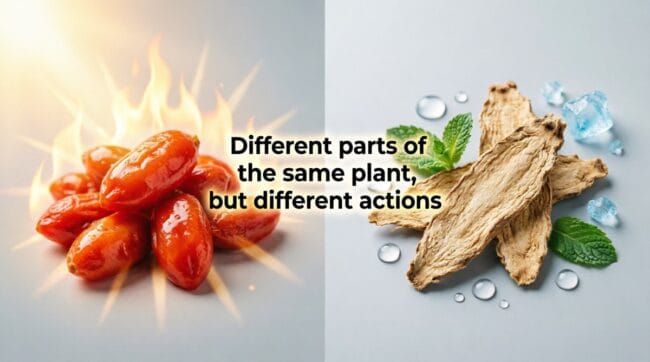
 In Traditional Chinese Medicine, two herbs come from the same plant yet behave in almost opposite ways:
- Gou Qi Zi — nourishing, blood and yin tonic
- Di Gu Pi — cooling, clears deficiency heat
Both come from the same botanical source, Lycium barbarum, yet their physiological effects appear almost reversed.
From a biomedical perspective, this makes sense when we look at plant tissue chemistry rather than just the plant species.
1. Gou Qi Zi: the “nutrient-building” fruit
Goji berries are metabolically rich reproductive structures designed by the plant to support seed survival and dispersal.
Key compounds include:
- Lycium barbarum polysaccharides (LBPs)
- Carotenoids (especially zeaxanthin)
- Betaines
- Amino acids and trace minerals
What this means biologically:
- Antioxidant protection: carotenoids reduce oxidative stress at a cellular level
- Immune modulation: LBPs influence cytokine signaling and immune balance
- Metabolic support: improves energy utilization and recovery pathways
- Hepatoprotective effects: supports liver resilience under stress
Overall, Gou Qi Zi behaves like a nutrient-dense, restorative botanical, supporting tissue building and recovery — consistent with its traditional use for Blood and Liver/Kidney Yin deficiency.
2. Di Gu Pi: the “regulatory cooling” bark
In contrast, Di Gu Pi is the protective root bark tissue of the plant — a defensive layer exposed to environmental stress.
It contains:
- Flavonoids and phenolic acids
- Minor steroidal alkaloid fractions
- Bioactive anti-inflammatory compounds
- Vasomodulating constituents
What this means biologically:
- NF-κB downregulation: reduces inflammatory signaling pathways
- COX-2 modulation: lowers prostaglandin-mediated inflammation and pain
- Antipyretic effects: reduces fever-like inflammatory states
- Microcirculation effects: improves peripheral blood flow and disperses localized heat patterns
Instead of building tissue, Di Gu Pi behaves more like a regulatory and anti-inflammatory agent, modulating overactive inflammatory responses.
3. Why the same plant produces opposite effects
The key lies in plant biology:
Fruit (Gou Qi Zi)
- Designed for reproduction
- Rich in sugars, pigments, and nutrients
- Biologically oriented toward growth and nourishment
Root bark (Di Gu Pi)
- Designed for protection and survival
- Rich in phenolic compounds and defensive metabolites
- Biologically oriented toward stress response and inflammation control
In simple terms:
- Fruit = metabolic support system
- Bark = protective regulatory system
4. How this maps to Traditional Chinese Medicine
TCM categorizes herbs by functional energetics:
- Gou Qi Zi → sweet, slightly warm → nourishes Blood and Yin
- Di Gu Pi → sweet-bitter, cold → clears deficiency heat
Modern pharmacology provides a parallel interpretation:
- “warming tonics” often correlate with nutrient density and metabolic activation
- “cooling herbs” often correlate with anti-inflammatory and immune-regulating activity
While not a perfect one-to-one mapping, the directional logic is remarkably consistent.
5. Clinical insight
This distinction explains why practitioners sometimes combine both:
- Gou Qi Zi builds the system
- Di Gu Pi prevents that building process from generating excess heat or irritation
Together, they reflect a core principle in Chinese herbal medicine:
Tonify without overheating, cool without collapsing function.
This balance is especially relevant in modern chronic conditions where deficiency and inflammation coexist.
👤 About Heiko Lade Heiko Lade is a New Zealand–registered Chinese herbalist with over 40 years of clinical experience. He has lectured in Chinese herbal medicine in both New Zealand and Australia, and continues to mentor and supervise students in his Hastings clinic.
Disclaimer: The information provided on this website is for educational purposes only and is not intended as a substitute for professional medical advice, diagnosis, or treatment. Individual responses to Chinese herbal medicine can vary. Herbal prescriptions are tailored to the individual and should be taken under the guidance of a registered Chinese herbal medicine practitioner. If you have a medical condition or are taking prescription medications, please consult your healthcare provider before starting any new treatment. No specific outcomes are guaranteed, and any discussion of treatment response reflects general clinical experience only.
If you ever have questions about why your herbs have been adjusted, just ask—understanding your treatment is part of the process.
