When people experience tightness in the thighs, abdomen, chest, or neck, it often feels like separate problems.
But in Traditional Chinese Medicine, these regions are connected through one functional pathway called the Stomach sinew channel — a continuous line of muscle and connective tissue running along the front of the body.
When this system becomes tight, people may notice:
- tight hip flexors or thighs
- abdominal gripping or tension
- restricted breathing or chest tightness
- neck stiffness or jaw tension
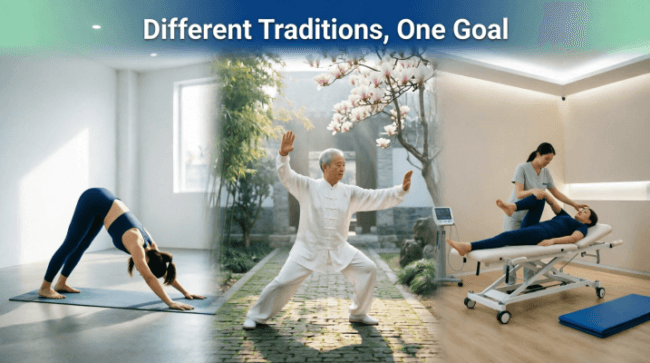
Rather than treating each area separately, many movement traditions work on this same front-body line in different ways.
One body system — three movement languages
Although Yoga, Qigong, and modern clinical physical therapies come from very different cultures, they often address the same physical pattern: a shortened, over-tensioned front body chain.
🧘♀️ Yoga (India): deep front-body opening
A well-known example is Camel Pose (Ustrasana).
This posture:
- stretches the quadriceps and hip flexors
- opens the abdomen and chest
- expands the rib cage for deeper breathing
- encourages spinal extension and upright posture
It is often described as an “opening” pose because it reverses the forward, closed posture many people develop from sitting.
🐉 Qigong / Ba Duan Jin (China): gentle expansion through breath
In Qigong, movements such as “Two Hands Hold Up the Heavens” create a similar effect:
- lengthening through the torso
- opening the chest and ribs
- coordinating breath with full-body extension
Instead of strong stretching, Qigong uses soft, repeated opening with breathing, helping the body gradually release tension through the same front-body pathway.
🧍♂️ Modern clinical therapeutic stretching
In the modern clinic, with exercise based rehabilitation, the same region is often treated with:
- hip flexor stretches (lunging positions)
- quadriceps stretching
- abdominal and chest opening exercises
- thoracic extension work
These exercises aim to restore:
- posture
- breathing mechanics
- balanced muscle length
- efficient movement patterns
🔗 Same target, different systems
Even though the language is different:
- Yoga speaks in posture and energetic opening
- Qigong speaks in Qi flow and breath coordination
- Science speaks in muscle, fascia, and biomechanics
All three are often working on the same functional structure:
the anterior body chain — closely related to what TCM describes as the Stomach sinew channel.
💡 Why this matters clinically
Acupuncture can help by:
- reducing muscle guarding
- regulating nervous system tone
- improving circulation and pain response
But movement is what helps the body keep the change.
Without restoring length and function through exercise, the body often returns to its old pattern.
🧭 A simple way to think about recovery
A useful combined approach may include:
- acupuncture → reduces tension and resets regulation
- therapeutic stretching → restores tissue length
- yoga or qigong → integrates breath, posture, and awareness
🌿 Final thought
Different cultures developed different systems, but they often observed the same thing:
when the front body opens, breathing deepens, posture improves, and movement becomes easier.
Whether through Camel Pose, Qigong lifting, or focused clinical stretching, the goal is the same:
Restore length, freedom, and coordination through the front body so the system can function as a whole again.
Compliance Note (New Zealand)
👤 About Heiko Lade Heiko Lade is a New Zealand–registered Chinese herbalist and acupuncturist with over 40 years of clinical experience. He has lectured in Chinese herbal medicine in both New Zealand and Australia, and continues to mentor and supervise students in his Hastings clinic.
Disclaimer: The information provided on this website is for educational purposes only and is not intended as a substitute for professional medical advice, diagnosis, or treatment. Individual responses to Chinese herbal medicine and acupuncture can vary. Herbal prescriptions and acupuncture are tailored to the individual and should be taken under the guidance of a registered Chinese herbal medicine or Acupuncturist. If you have a medical condition or are taking prescription medications, please consult your registered healthcare provider before starting any new treatment. No specific outcomes are guaranteed, and any discussion of treatment response reflects general clinical experience only.
